Saturday, January 6, 2018

Woman Who Helped Found Hartford — Dorothy Hooker

B. about 1589 in (probably) Marefield, Leicestershire, England1
M. 1 Jun 1609 in Birstall, England1
Husband: John Chester
D. before 27 May 1662 in Hartford, Connecticut1

Dorothy Hooker’s life was largely shaped by the fact her brother was a prominent Puritan minister. But she had enough status in her own right to later have her name engraved on a monument as a founder of a city.

Dorothy was born in about 1589, probably in the village of Marefield, England,1 which was in Leicestershire. Her parents were Thomas Hooker and Susannah Pym, and she was one of at least six children. On June 1, 1609, Dorothy married John Chester at Bristall, England.1 They had two known children, one of whom died likely as an infant. John died in 1628, leaving Dorothy as a widow.

Even though Dorothy was about 38-years-old, she opted to not get remarried. Instead, she seemed to follow the path of Reverend Thomas Hooker, her older brother. Hooker began preaching at a time when Puritans were under the threat of authorities in England. For a few years, he escaped persecution by moving to the Netherlands, then he made the decision to migrate to Massachusetts. He arrived on the ship Griffin on September 4, 1633 along with his wife and children, and it's likely that Dorothy and her son Leonard were also on the ship.2

Reverend Hooker first settled in Newtown, Massachusetts, but had disagreement over some issues with the colony leaders, and he made plans to settle elsewhere. He obtained a grant of land in the Connecticut valley, and in 1636 led a group of 100 people there. They were the original settlers of Hartford, and Dorothy was among them.1

Painting of Rev. Hooker's 1636 journey into Connecticut.

Dorothy's brother had a significant influence on Hartford during its early days. Hooker felt that all Christian men should have the right to vote, not just those who had been through the screening process of becoming a freeman. He once said, “The foundation of authority is laid firstly in the free consent of the people.”3 In January 1639, he and his followers created a document called “Fundamental Orders of Connecticut,” which is been thought to have been the earliest “democratic constitution establishing a representative government” in the world.3

Shortly after the Fundamental Orders were ratified, the land in Hartford was divided into lots for the settlers. Dorothy may have been the only woman to be given land in her own right.1 Her town lot was shown on a 1640 map to be at the end of a block of what was later Main Street.4 She was given two years to build a house there; it’s not known if she actually did.

1640 Hartford map showing the plot of land granted to Dorothy.

Dorothy’s name turned up in early Hartford court records. In 1649, she made a complaint against three people named George Chappell, Goody Coleman and Daniel Turner whom she accused of “misdemeanors.”5 Daniel Turner was mentioned as having “libeled” Dorothy, and he was given a harsh sentence that included both a prison term and two public whippings.

Reverend Hooker died in 1647,3 and Dorothy’s son Leonard passed away in 1648.6 Sometime in 1662, Dorothy's estate was inventoried on May 27, 1662,1 so we know that she died by that date. Years later, she would be one of only two women named on the Hartford Founders Monument. Dorothy left some noteworthy descendants, including Calvin Coolidge, Bette Davis, Endicott Peabody (governor of Massachusetts), writer Archibald MacLeish, actor Orson Bean, and Kyra Sedgwick.7

Hartford Founders' Monument showing Dorothy Chester.

Children:
1. Leonard Chester — B. 15 Jul 1610, Blaby, Leicestershire, England;6 D. 11 Dec 1648, Wethersfield, Connecticut;6 M. Mary ______ (~1608-1688), 1634, Wethersfield, Connecticut1

2. Elizabeth Chester — B. 6 Feb 1625, England;1 D. young

Sources:
1    The Great Migration Begins: Immigrants to New England, 1620-33, Robert Charles Anderson, 1995
2    According to GMB, she was in the colony by late 1634 — her connection to Thomas Hooker makes it seem likely she traveled with him.
3    Thomas Hooker (Wikipedia article) — both citations in his paragraph, plus his death in last paragraph
4    The Memorial History of Hartford County, Connecticut, 1633-1884, Volume 1, James Hammond Trumbull, 1886
5    A Catalogue of the Names of the early Puritan Settlers of the Colony of Connecticut, Royal Ralph Hinman, 1852
6    Find-a-Grave listing of Leonard Chester
7    FamousKin.com listing of Dorothy Hooker

Friday, January 5, 2018

English Girl Immigrant to Canada — Rebecca Pepperell

B. 1798 in St. Albans, Hertfordshire, England1
M. before 1820 in (probably) Charlottetown, Prince Edward Island2
Husband: Job Bevan
D. 17 Dec 1868 in Charlottetown, Prince Edward Island2

One day in 1809, a ship sailed into Canada, carrying passengers from England seeking a new life. Among them was a 10-year-old girl, Rebecca Pepperell, and as the ship docked, she saw for the first time the place she make her home — Charlottetown, Prince Edward island. 

Arriving in Canada. (AI-generated image)

Rebecca was born in 1798 in St. Albans, England to William Pepperell and Mary Browne,1 one of eight children, seven of whom were girls. Her parents were originally from Durnford, in Wiltshire County,4 and didn’t have roots in St. Albans. By the time Rebecca was 6-years-old, her family had moved to the city of Bristol.5 It isn’t certain if there were any other places in England where they lived during her early childhood.

There’s no record of what prompted the Pepperell family to resettle in Canada by the end of 1809,6 but conditions in England may have had something to do with it. The beginning of the industrial revolution meant a shift in what skills were needed to make a living, plus a population boom was making cities like Bristol crowded. As with others from Europe before and after, finding a more secure future was likely a motivation for the Pepperells to become immigrants.

Prince Edward Island was going through a transition when young Rebecca arrived. Once called Île d’St-Jean, the first colonists to settle there were French. After England took over Canada in 1763, families from Scotland and loyalists from the American colonies were encouraged to come. But around 1810, a new group of people started moving in, and they were from England. With the English becoming well-established there, it must have given the Pepperell family a sense of familiarity.

Charlottetown in the early 19th century.

Sometime before 1820, Rebecca married a soldier from Bath, England named Job Bevan. After Job’s military service ended, he made a living as a carpenter.7 They would have eight children born between 1820 and 1845. Rebecca was a member of St. Paul’s Anglican Church in Charlottetown, where her father was a sexton, and her husband was a beadle.8

Job died on January 6, 1862,9 and Rebecca was listed as his widow in the 1864 directory, living in a house on Prince Street near Kent.10 She passed away on December 17, 1868.3 Her obituary said she died after “a long and painful illness.”11 She was buried in the Old Protestant Burying Ground in Charlottetown.

Rebecca’s descendants would scatter widely across Canada and the U.S. One daughter moved to Boston, a son went to New Jersey, another daughter to Seattle, and another son to Victoria, British Columbia.

Children:

1. Maria Bevan — B. 5 Oct 1820, Halifax, Nova Scotia;2 D. 14 Dec 1888, Boston, Massachusetts;12 M. (1) John Baird, 15 Jan 1838, Charlottetown, Prince Edward Island;13 (2) Charles W. Hughes (1819-?), 15 Jun 1842, Charlottetown, Prince Edward Island;14 (3) John Costigan (1829-?), 20 May 1867, Boston, Massachusetts15

2. William Bevan — B. 26 Mar 1823, Charlottetown, Prince Edward Island;16 D. 26 Feb 1880, Charlottetown, Prince Edward Island;17 M. Hannah Vessey (1825-1904), 16 Jan 1846, Prince Edward Island18

3. James Job Bevan — B. 1827, Charlottetown, Prince Edward Island;19 D. 17 Oct 1859, Trenton, New Jersey;19 M. Sophia Elizabeth Wiseman, 11 Nov 1858, Trenton, New Jersey20

4. Sarah Ann Bevan — B. 3 Oct 1830, Charlottetown, Prince Edward Island;21 D. 26 Nov 1924, Seattle, Washington;21 M. Daniel McKinnon (1833-1895), 20 Oct 1854, Prince Edward Island22

5. Job Bevan — B. 18 Mar 1834, Charlottetown, Prince Edward Island;23 M. Abigail Treneman (~1837-?), 5 Aug 1858, Prince Edward Island24

6. Rebecca Bevan — B. 9 May 1837, Charlottetown, Prince Edward Island;25 D. 12 Apr 1868, Charlottetown, Prince Edward Island;25 M. Charles Rodd (1839-1905), 26 May 1864, Prince Edward Island26

7. John Bevan — B. 18 Apr 1841, Charlottetown, Prince Edward Island;27 D. 17 Sep 1842, Charlottetown, Prince Edward Island27

8. Charles Frederick Bevan — B. 17 Jan 1845, Charlottetown, Prince Edward Island;28 D. 3 Jun 1926, Victoria, British Columbia;29 M. (1) Mary Gillis (1847-bef 1877), 12 Nov 1868;30 (2) Mary Helen Moody (1843-1900), 1877;31 (3) Hattie Ann Gray (1857-1929), 23 Nov 1908, Victoria, British Columbia32

Sources:
1   Find-a-Grave listing of Rebecca (Pepperell) Bevan 
2   Find-a-Grave listing of Maria (Bevan) Hewes (firstborn child of Rebecca) 
3   Death record of Rebecca Bevan, Canada, Prince Edward Island Death Card Index, 1721-1905, FamilySearch.org  
4   Marriage record of William Pepperell and Mary Brown, England, Wiltshire, Church Records, 1518-1990, FamilySearch.org  
5   Birth record of Marie Pepperall, “The Descendants of Patrick Callaghan and Maria Pepperall,” Ron Nelson, islandregister.com  
6   William’s daughter Louisa was listed in St. Paul’s Anglican Church records as being born in Charlottetown on December 31, 1809.
7   “The Descendants of Joshua Bevan,” Steven Meeken, islandregister.com 
8   Records of St. Paul’s Anglican Church, Charlottetown, Prince Edward Island
9   Death notice of Job Bevan, The Examiner, Prince Edward Island, 13 Jan 1862
10  Hutchinson’s Prince Edward Island City Directory, 1864
11  Death Notice of Rebecca Bevan, The Examiner, Prince Edward Island, 4 Jan 1869
12  Death record of Maria Hughes, Massachusetts, U.S., Death Records, 1841-1915, FamilySearch.org
13  Marriage record of John Baird and Maria Bevan, Records of Prince Edward Island Heritage Foundation
14  Military records of Charles Hughes, 5 March 1846, Halifax, Nova Scotia
15  Marriage record of John Costigan and Maria Hughes, Massachusetts, U.S., Marriage Records, 1840-1915, FamilySearch.org
16  Baptismal record of William Bevan, Prince Edward Island, Baptism Index, 1788-1943, Ancestry.com
17  Find-a-Grave listing of William Bevan 
18  Marriage record of William Bevan and Hannah Vessey, Canada, Prince Edward Island Marriage Registers, 1832-1888, FamilySearch.org  
19  Find-a-Grave listing of James Job Bevan 
20  Marriage record of James J. Bevan and Sophia E. Wiseman, New Jersey, U.S., Marriage Records, 1670-1965, Ancestry.com
21  Death record of Sarah Ann MacKinnon, Washington, U.S., Death Records, 1907-1017, Ancestry.com
22  Marriage record of Daniel McKinnon and Sarah Ann Bevan, C., P. E. I. M. R.
23  Baptismal record of Job Bevan, P. E. I., B. I.  
24  Marriage record of Job Bevan and Abigail Treneman, C., P. E. I. M. R.  
25  Find-a-Grave listing of Rebecca (Bevan) Rodd 
26  Marriage record of Charles Rodd and Rebecca Pepperell, C., P. E. I. M. R. 
27  Find-a-Grave listing of John Bevan  
28  Baptismal record of Charles Bevan, P. E. I., B. I. 
29  Find-a-Grave listing of Charles Frederick Beavan 
30  Marriage record of Charles Bevan and Mary Gillis, C., P. E. I. M. R. 
31  Find-a-Grave listing of Mary Helen (Moody) Beavan 
32  Marriage record of Charles Frederick Bevan and Hattie Ann Gray, British Columbia, Canada, Marriage Index, 1872-1935, Ancestry.com

Thursday, January 4, 2018

3 Months in Iroquois Captivity — Pierre Lefebvre

B. 20 Oct 1623 in Sceaux, Ile-de-France, France1
M. about 1645 in (probably) Trois-Riviéres, New France2
Wife: Jeanne Aunois
D. about 1668 in Trois-Riviéres, New France3

People who lived in New France during its earliest years were under a nearly constant threat from the Iroquois. And for those who lived upriver from Quebec City, the odds of being met with violence were much greater. For Pierre Lefebvre, this meant being captured and held for months, not knowing if he would survive.

Pierre was born in the town of Sceaux, France to Pierre Lefebvre and Jeanne Cutiloup on October 20, 1623.1 After he came of age, he migrated to America, first appearing in records on April 11, 1643 as a trial witness at Trois-Riviéres.4 This would be where Pierre made his home, and on August 15, 1644, he received a grant of land from the governor. Sometime in the next couple years, he married a woman named Jeanne Aunois,2 and they had seven children born between 1647 and 1661.

Location of Trois-Rivières.

During the 1640s, Trois-Riviéres was on the frontier of New France. Located at the mouth of the Saint-Maurice River on the north shore of the St. Lawrence, the settlement was quite a distance west of Quebec City. The French needed places like this to expand the fur trade, but being so remote came with the tension of being outnumbered by Canada's indigenous tribes. They had a good relationship with the Hurons and others, but not with the Iroquois

On July 14, 1648, Pierre was among some French and Hurons who were attacked by Iroquois while guarding cattle on the outskirts of Trois-Riviéres. Others rushed to their aid, but the attackers had already killed two men, and taken others prisoner, including Pierre. The frightened captives were led away, and Pierre was held for three months; his then-pregnant wife must have thought him dead. But in October, he returned home accompanied by one of the Iroquois. It isn't known why Pierre was released.4

Frenchmen captured by Iroquois. (AI-generated image)

As time went on, more settlements developed along the St. Lawrence,4 and Trois-Rivières became a somewhat safer place. Pierre acquired several pieces of land in the area, including a tiny island at the mouth of the Saint-Maurice River only one-acre in size. In 1647, he was granted a large tract of land on the southern shore of the St. Lawrence, but the location was too remote to safely develop it at the time. A couple of years later, in 1650, Pierre acquired a lot in Trois-Riviéres with a house;4 it’s believed that he rented it out to tenants, and by the 1660s, the house had fallen into ruin.4 Pierre also owned land in Cap-de-la-Madeleine which he bought in 1656,4 and this may have been his family home.

After Pierre’s experience with the Iroquois, he appeared to show caution in dealing with them. He joined an effort to build a stockade around Trois-Rivières,5 and in 1652, when others went out seeking to confront the Iroquois, he chose to stay behind in town.5 Pierre was sometimes mentioned in Trois-Riviéres records involving civil matters. He was said to have served as “mayor” in 1658 and 1660,4 then in 1663, he was the church warden.4 The following year, he was on a panel of three men arbitrating a dispute between a priest and a habitant. And he was one of the people who helped build the church.4

In 1666, Pierre was given another piece of land in Cap-de-la-Madeleine by the Jesuits,4 but he only lived about another two years. He died in about 1668 while only in his 40s.3 His wife Jeanne remarried on October 12, 1670,4 and passed away in 1697.6 They were ancestors of Justin BieberRicky Gervais and Emeril Lagasse.7

Children:
1. Jacques Lefebvre – B. 12 Jan 1647, Trois-Riviéres, New France;8 D. 19 Feb 1720, Baie-du-Febvre, New France;9 M. Marie Beaudry dit Lamarche (1650-1734), Trois-Riviéres, New France10

2. Marie-Catherine Lefebvre — B. 4 Dec 1648, Trois-Riviéres, New France;11 D. 30 Nov 1705, Batiscan, New France;12 M. Antoine Trottier (1640-1706), 2 Sep 1663, Cap-de-la-Madeleine, New France13

3. Élisabeth Lefebvre — B. 15 May 1651, Trois-Riviéres, New France;14 D. 30 Sep 1687, Batiscan, New France;15 M. (1) Felix Thunay dit Dufresne (1633-1683), 28 Dec 1665, Cap-de-la-Madeleine, Quebec;16 (2) Jean Collet (1637-1699), 13 Jan 1687, Batiscan, New France17

4. Michel Lefebvre – B. 3 Mar 1654, Trois-Riviéres, New France;18 D. 21 Oct 1708, Trois-Riviéres, New France;19 M. Catherine-Marie Trottier (1669-1723), 3 Nov 1683, Champlain, New France20

5. Ignace Lefebvre — B. 3 Apr 1656, Trois-Riviéres, New France;21 D. 27 Mar 1740, Trois-Riviéres, New France;22 M. Marie Trottier (1667-1740), Champlain, New France23

6. Ange Lefebvre — B. 19 Sep 1658, Trois-Riviéres, New France;24 D. 25 Dec 1735, Becancour, New France;25 M. (1) Marie-Madeleine Cusson (1659-1720), about 1680, Champlain, New France;26 (2) Genevieve Guillet (1665-1741), 22 May 1724, Becancour, New France27

7. Pierre Lefebvre – B. 30 Sep 1661, Trois-Riviéres, New France;28 D. 3 Oct 1745, Trois-Riviéres, New France;29 M. Marie-Louise Daniau (1691-1764), 3 Sep 1731, Nicolet, New France30

Sources:
1    WikiTree listing of Pierre Lefebvre  
2    Généalogie du Québec et d'Amérique française listing of Pierre Lefebvre 
3    Testimony of witnesses against Jeanne Aunois (Pierre’s widow), January 1, 1669, BAnQ
4    Our French-Canadian Ancestors, Gerard Lebel (translated by Thomas J. Laforest), 1988
5    “The French Connection – Part 8 – Trois Riviers and Pierre Lefebvre,” Lighten up Brighten up (blog), 13 Aug 2014  
6    Burial record of Jeanne Aunois, Quebec Catholic Parish Registers, 1621-1979, FamilySearch.org
7    FamousKin listing of Pierre Lefebvre  
8    Baptismal record of Jacques Lefebvre, Q.C.P.R.
9    Burial record of Jacques Lefebvre, Q.C.P.R.
10  Marriage record of Jacques Lefebvre and Marie Beaudry dit Lamarche, Q.C.P.R.
11  Baptismal record of Marie-Catherine Lefebvre, Q.C.P.R.
12  Burial record of Marie-Catherine Lefebvre, Q.C.P.R.
13  Marriage record of Antoine Trottier and Marie-Catherine Lefebvre, Q.C.P.R.
14  Baptismal record of Élisabeth Lefebvre, Q.C.P.R.
15  Burial record of Élisabeth Lefebvre, Q.C.P.R.
16  Marriage record of Felix Thunay dit Dufresne and Élisabeth Lefebvre, Q.C.P.R.
17  Marriage record of Jean Collett and Élisabeth Lefebvre, Q.C.P.R.
18  Baptismal record of Michel Lefebvre, Q.C.P.R.
19  Burial record of Michel Lefebvre, Q.C.P.R.
20  Marriage record of Michel Lefebvre and Catherine-Marie Trottier, Q.C.P.R.
21  Baptismal record of Ignace Lefebvre, Q.C.P.R.
22  Burial record of Ignace Lefebvre, Q.C.P.R.
23  Marriage record of Ignace Lefebvre and Marie Trottier, Q.C.P.R.
24  Baptismal record of Ange Lefebvre, Q.C.P.R.
25  Burial record of Ange Lefebvre, Q.C.P.R.
26  Marriage record of Ange Lefebvre and Marie-Madeleine Cusson, Q.C.P.R.
27  Marriage record of Ange Lefebvre and Genevieve Guillet, Q.C.P.R.
28  Baptismal record of Pierre Lefebvre, Q.C.P.R.
29  Burial record of Pierre Lefebvre, Q.C.P.R.
30  Marriage record of Pierre Lefebvre and Marie-Louise Daniau, Q.C.P.R.

Passing Father’s Land to His Son — Antoine Bordeleau

B. 18 Dec 1673 in Neuville, New France1
M. 5 Mar 1696 in Neuville, New France2
Wife: Catherine Piché
D. 4 May 1758 in Neuville, New France3

Sometimes it’s the land that tells the story of those who came before us. Antoine Bordeleau’s land left a remarkable legacy in that a charming house standing there today still bears his name — Maison Bordeleau.

Antoine Bordeleau was born in Neuville, New France on December 18, 1673 to Antoine Bordeleau and Pérette Hallier.1 Like many of his generation, his father had been a Carignan-Sallieres Regiment soldier and his mother was a Fille du Roi. Antoine only had one sibling, a younger sister,4 which was unusual in a colony that encouraged its settlers to have large families. When Antoine was about 8-years-old, his mother returned to France, abandoning his father, who was left to raise the two children alone.5

When Antoine was 20-years-old, he spent several weeks in Hotel-Dieu, the hospital in Quebec City;6 it’s unknown what sort of sickness or injury brought him there. A couple of years later on Mar 5, 1696, he married Catharine Piché,2 a young woman from another family who had settled in Neuville. Antoine and Catherine had 16 children between the years 1696 and 1720, of whom six died as infants.

On August 19, 1700, Antoine’s father gave him land that had been deeded to him in 1669.7 Antoine held onto this land until December 20, 1741 when he gave it to his two youngest sons, Louis and Etienne.8 It’s believed that at his time, Etienne began construction of a house, and this became Maison Bordeleau.9 The property remained in the Bordeleau family until 1825. In 2011, the house was beautifully restored, preserving its original floors, beams and exposed stone walls. The house is considered to be one of the oldest surviving dwellings in Neuville.9

Maison Bordeleau in Neuville, Quebec

Since Maison Bordeleau had been built in Antoine’s lifetime, he likely was at least a visitor to it, perhaps even living in one of its rooms. He passed away on May 4, 1758 in Neuville.3 It’s not known when his wife Catherine died. 

Children:
1. Antoine Bordeleau — B. 14 Dec 1696, Neuville, New France;10 D. about 23 Jan 1697, Neuville, New France11

2. Jean-Baptiste Bordeleau — B. 10 Nov 1697, Neuville, New France;12 D. before Nov 1760, Neuville, New France;13 M. (1) Marie-Anne Fauteux (1683-1758), 14 Jul 1721, Neuville, New France;14 (2) Marie-Françoise Béland (1715-1805), 11 Jan 1759, Neuville, New France15

3. Marie-Catherine Bordeleau — B. 15 Aug 1699, Neuville, New France;16 D. 14 Nov 1767, St-Nicolas, Quebec;17 M. (1) René Rousseau (1688-1744), 9 Sep 1737, Neuville, New France;18 (2) Joseph Bergeron (1699-1772), 3 Oct 1745, St-Nicolas, New France19

4. Antoine Bordeleau — B. 23 Oct 1701, Neuville, New France;20 D. 20 Sep 1735, Quebec City, New France;21 M. Madeleine-Angélique Savary (1708-1782), 4 Nov 1727, Neuville, New France22

5. Marie-Angélique Bordeleau — B. 15 Apr 1704, Neuville, New France;23 D. 10 Jun 1761, Neuville, New France;24 M. Pierre Sylvestre (1704-?), 26 Feb 1732, Pointe-aux-Trembles, New France25

6. Marie-Louise Bordeleau — B. 11 Aug 1706, Neuville, New France;26 D. 3 May 1783, Neuville, Quebec;27 M. Ignace Grégoire (1709-1788), 1 Mar 1734, Neuville, New France28

7. François Bordeleau — B. 16 Aug 1708, Neuville, New France;29 D. 16 Aug 1708, Neuville, New France30

8. François de Sales Bordeleau — B. 10 Aug 1709, Neuville, New France;31 D. 1 Nov 1710, Neuville, New France32

9. Louis-Joseph Bordeleau — B. 7 Jan 1711, Neuville, New France;33 M. Marie-Madeleine Laberge (1695-?), 30 Jun 1738, Neuville, New France34

10. Marie-Claire Bordeleau — B. Feb 1712, Neuville, New France;35 D. Nov 1712, Neuville, New France36

11. Antoinette Bordeleau — B. 19 Feb 1713, Neuville, New France;37 D. 22 Feb 1715, Neuville, New France38

12. Marie-Françoise Bordeleau — B. 15 Mar 1714, Neuville, New France;39 D. 24 Nov 1773, Ste-Famille, Cap-Santé, Quebec;40 M. Joseph-Marie Potrel, 30 Aug 1756, Neuville, New France41

13. Michel Bordeleau — B. Jun 1715, Neuville, New France;42 D. Aug 1715, Neuville, New France43

14. Louis Bordeleau — B. 7 Jun 1716, Neuville, New France;44 M. Geneviéve Dion (1717-?), 19 Aug 1743, Neuville, New France45

15. Etienne Bordeleau — B. 2 Nov 1717, Neuville, New France;46 D. 8 Jul 1781, Neuville, Quebec;47 M. (1) Geneviéve Béland (1719-1748), 17 Apr 1747, Pointe-aux-Trembles, New France;48 (2) Louise Aide (1726-1769), 9 Feb 1750, Neuville, New France49

16. Marie-Anne Bordeleau — B. 25 Jul 1720, Neuville, New France;50 M. Jean-François Pinel (1721-?), 1 Aug 1746, Neuville, New France51

Sources:
1    Baptismal record of Antoine Bordeleau, Quebec Catholic Parish Registers, 1621-1979, FamilySearch.org
2    Marriage record of Antoine Bordeleau and Catherine Piché, Q.C.P.R.
3    Burial record of Antoine Bordeleau, Q.C.P.R.
4    Baptismal record of Marie-Louise Bordeleau (sister), Q.C.P.R.
5    King’s Daughters and Founding Mothers—1663-1673, Peter Gagne, 2000
6    Le Registre journalier des malades de l’Hotel-Dieu de Quebec, Marcel Fournier and Giséle Monarque, 2005
7    Généalogie du Quebec et d’Amérique française listing for Antoine’s father 
8    Donation by Antoine Bordeleau and Marie-Catherine Pichet (Piché), husband and wife, to Louis Bordeleau and Étienne Bordeleau, BAnQ, 20 Dec 1741 
9    D’Histoire Société de Neuville, Maisons ancestrales
10  Baptismal record of Antoine Bordeleau (older son), Q.C.P.R.
11  Burial record of Antoine Bordeleau (older son), Q.C.P.R.
12  Baptismal record of Jean-Baptiste Bordeleau, Q.C.P.R.
13  Généalogie du Quebec et d’Amérique française listing of Jean-Baptiste Bordeleau
14  Marriage record of Jean-Baptiste Bordeleau and Marie-Anne Fauteux, Q.C.P.R.
15  Marriage record of Jean-Baptiste Bordeleau and Marie-Françoise Béland, Q.C.P.R.
16  Baptismal record of Marie-Catherine Bordeleau, Q.C.P.R.
17  Burial record of Marie-Catherine Bordeleau, Q.C.P.R.
18  Marriage record of René Rousseau and Marie-Catherine Bordeleau, Q.C.P.R.
19  Marriage record of Joseph Bergeron and Marie-Catherine Bordeleau, Q.C.P.R.
20  Baptismal record of Antoine Bordeleau (younger son), Q.C.P.R.
21  Burial record of Antoine Bordeleau (younger son), Q.C.P.R.
22  Marriage record of Antoine Bordeleau and Madeleine-Angélique Savary, Q.C.P.R.
23  Baptismal record of Marie-Angelique Bordeleau, Q.C.P.R.
24  Burial record of Marie-Angelique Bordeleau, Q.C.P.R.
25  Marriage record of Pierre Sylvestre and Marie-Angeleique Bordeleau, Q.C.P.R.
26  Baptismal record of Marie-Louise Bordeleau (daughter), Q.C.P.R.
27 Burial record of Marie-Louise Bordeleau (daughter), Q.C.P.R.
28  Marriage record of Ignace Grégoire and Marie-Louise Bordeleau, Q.C.P.R.
29  Baptismal record of François Bordeleau, Q.C.P.R.
30  Burial record of François Bordeleau, Q.C.P.R.
31  Baptismal record of François de Sales Bordeleau, Q.C.P.R.
32  Burial record of François de Sales Bordeleau, Q.C.P.R.
33  Baptismal record of Louis-Joseph Bordeleau, Q.C.P.R.
34  Marriage record of Louis-Joseph Bordeleau and Marie-Madeleine Laberge, Q.C.P.R.
35  Baptismal record of Marie-Claire Bordeleau, Q.C.P.R.
36  Burial record of Marie-Claire Bordeleau, Q.C.P.R.
37  Baptismal record of Antoinette Bordeleau, Q.C.P.R.
38  Burial record of Antoinette Bordeleau, Q.C.P.R.
39  Baptismal record of Marie-Françoise Bordeleau, Q.C.P.R.
40  Burial record of Marie-Françoise Bordeleau, Q.C.P.R.
41  Marriage record of Joseph-Marie Potrel and Marie-Françoise Bordeleau, Q.C.P.R.
42  Baptismal record of Michel Bordeleau, Q.C.P.R.
43  Burial record of Michel Bordeleau, Q.C.P.R.
44  Baptismal record of Louis Bordeleau, Q.C.P.R.
45  Marriage record of Louis Bordeleau and Geneviéve Dion, Q.C.P.R.
46  Baptismal record of Etienne Bordeleau, Q.C.P.R.
47  Burial record of Etienne Bordeleau, Q.C.P.R.
48  Marriage record of Etienne Bordeleau and Geneviéve Béland, Q.C.P.R.
49  Marriage record of Etienne Bordeleau and Louise Aide, Q.C.P.R.
50  Baptismal record of Marie-Anne Bordeleau, Q.C.P.R.
51  Marriage record of Jean François Pinel and Marie-Anne Bordeleau, Q.C.P.R.

Tuesday, January 2, 2018

First Minister of Lynn, Massachusetts — Samuel Whiting

B. 20 Nov 1597 in Boston, England1
M. (1) (probably) about 1623 in England1
Wife: unknown
M. (2) 6 Aug 1629 in Boston, England1
Wife: Elizabeth St. John
D. 11 Dec 1679 in Lynn, Massachusetts1

Reverend Samuel Whiting was one of the most important Puritan ministers in New England, and the first to head the congregation at Lynn, Massachusetts. Such men were early leaders in colonial America, and in a way, they were among the seeds which led to the founding of the United States.

Samuel was born in Boston, England on November 20, 1595, to John and Isabel Whiting, one of six children.1 His father was a merchant and town council member who was voted as mayor in 1600 and 1608.1 Because of his father’s position, Samuel grew up around people like Reverend John Cotton, who was the church rector in Boston and an outspoken Puritan. It's very likely that Reverend Cotton influenced Samuel to pursue a career in the ministry.

Samuel attended Emanuel College at Cambridge, where he received a bachelor’s degree in 1616 and a masters degree in 1620; he later earned a doctorate as well.1 Emmanuel College was considered “the hotbed of Puritanism.”1 The religion Samuel was indoctrinated in believed that kings had no “divine right” to oversee church matters.1 This basic belief guided him throughout his life.

In 1617, Samuel’s father died, and left him £120 in his will,1 a large sum of money for the time. After he finished college, Samuel’s first assignment was as chaplain to a family in Norfolk consisting of “five ladies and two knights.”1 He was said to have met “distinguished personages” during those years. Three years later, he took an assignment at Kings Lynn, but after another three years, he was forced out due to complaints from his parishioners about his Puritan preaching.1 Samuel was fearful of losing some of his estate because of the dismissal, but was saved by the fact that King James I died, and the authorities were more focused on the transition to a new king.1

The church at King's Lynn.

Samuel had gotten married during the time he was in Kings Lynn, but his wife, whose name is unknown, died within a few years.1 There were three children born to his wife, only one of which, a girl, survived. After the end of his time at Kings Lynn, Samuel took a rectorship at Skirbeck, a town near Boston.1 In 1629, he married Elizabeth St. John,1 a woman he had known since his time in Norfolk. They had a son named Samuel, born in 1633.1

At the time Samuel preached in Skirbeck, Reverend Cotton was still the rector at Boston, and Samuel’s brother John was mayor.1 Complaints of non-conformity were made against both ministers. Reverend Cotton left for America first, escaping in disguise in 1633.1 Samuel continued longer, partly because of his brother’s position. He was advised by friends to modify his preaching, but this went against his honest nature. Although he wanted to remain there, he made the decision to move to New England so that he could be true to his beliefs without “a life of humiliating submission to the bishops” in England.1 He sold all of his property and prepared to move. He said, “I am going into the wilderness to sacrifice unto the Lord, and I will not leave a hoof behind me.”1

On the ship, Samuel was very seasick and managed to deliver only one sermon during the voyage. He later said, “I would much rather have undergone six weeks’ imprisonment for a good cause than six weeks of such terrible sea-sickness.”1 He arrived in Boston, Massachusetts on May 26, 1636, and spent the first month with a friend, Atherton Hough.1 Then later that year, he went to Saugus to become the first minister there.1 Soon after, Saugus was renamed in his honor as Lynn, after the town of Kings Lynn, where he served in England.1 Samuel was formally made pastor on November 8, 1636, and he established his home with his wife and two children across from the meetinghouse.1 Their garden was said to be known for its variety of fruit and vegetables, and for the apple cider produced by its trees. He also was given 200 acres of land in 1638.1 The first year he was settled there, a son named John was born.1 He would have two more children: Joseph in 1641 and Elizabeth in 1645.1

Samuel was said to be greatly respected by his community, and was “peculiarly amiable.”2 When among groups of people, he would “kiss all the maids” and “he felt all the better for it.”1 They were said to “hug their arms around his neck and kiss him right back.” Samuel was described as being “a man of middle size and straight fine hair.”1 He thought it was important to be well-dressed when he preached, saying that “his hearers should not be made to have their eyes upon an unseemly object, lest the good instruction might be swallowed up in disgust.”1

A story was told that happened during one of Samuel’s sermons: A young man had the job of poking those who nodded off during services with a foxtail attached to a stick. One day in 1647, a man named Tomlins was jolted awake and cursed loudly at an imaginary woodchuck, not realizing where he was. This caused Samuel to say to the congregation that he seems to be preaching to “sacks of straw with men sitting here and there among them.”1 Samuel was also known to sometimes interrupt his sermon and grab his hat as if to leave if too many of his audience had nodded off.1

Reacting to a sleepy congregation. (AI-generated image)

In 1649, Oliver Cromwell, who had just taken control of England, sent a request that Samuel and other prominent ministers in New England be sent to Ireland as missionaries to convert the Catholics there. The ministers including Samuel responded to Cromwell by letter, but nothing ever came of the plan.1

Samuel was a teacher to his children, including his daughters.1 His sons all went on to attend Harvard and later became ministers; Samuel himself was appointed as “overseer” at Harvard in 1654.1 He also educated others in the community, offering religious instruction and language lessons to children in Lynn.1 And in about 1646, Samuel took an Indian girl into his household given over by her mother. He gave her an education and she became a part of his family for a time and, but eight years later, she ran away back to her tribe. Samuel was said to be heartbroken when she left.1

In 1656, Samuel was one of 12 ministers appointed to a board representing all the New England colonies making decisions on matters of religion.1 He was known to have opinions favorable to the liberty of the citizens, even if their practice differed with his own.1 During the 1660s, when others were whipping and giving other cruel punishments to Quakers, Samuel wouldn’t condone it.1 He was firmly in favor of separation of church and state, and petitioned against the authority of the General Court over religious matters several times.1

Samuel's signature.

Samuel authored books on religion and a volume of sermons. In 1664, he published a book called,  “A Discourse of the Last Judgment,” about his views regarding Judgment Day. In the book, he wrote, “What is it to draw nigh to God in prayer? It is not to come with loud expressions when we pray to him. Loud crying in the ears of God is not to draw near to God. They are nearer to God that silently whisper in his ears and tell him what they want, and what they would have of him.”1 During his career, it was said that he knew Hebrew and “he was elegant with Latin.”1

Samuel’s wife died on March 3, 1677 in Lynn,3 and after that, his health deteriorated rapidly. He was said to be suffering from “a grinding and painful disorder,” and “scarce enjoyed a day of perfect ease,”1 though this didn’t stop him from his service to the community. About six months before he died, he submitted a claim to the General Court for 600 acres of land in return for money that he had arranged to be given to the colony in its early days. The deed of land was granted and was passed on to his heirs.1

He died on December 11, 1679 at his home in Lynn.1 He was given a funeral attended by many in the town and beyond, and buried in the churchyard. Samuel was the ancestor of Calvin Coolidge, Bette Davis, Orson Bean, Kyra Sedgwick and John Kerry.4

Children (by first wife):
1. Dorothy Whiting — B. before 14 May 1627, Skirbeck, England;5 D. 31 Jul 1694, Roxbury, Massachusetts;6 M. Thomas Weld (1626-1683), 4 Jun 1650, Roxbury, Massachusetts7

Children (by Elizabeth St. John):
1. Samuel Whiting — B. 25 Mar 1633, Skirbeck, England;1 D. 28 Feb 1713, Billerica, Massachusetts;8 M. Dorcas Chester (1637-1712), 12 Nov 1656, Wethersfield, Connecticut9

2. John Whiting — B. 1637, Lynn, Massachusetts;1 D. 11 Oct 1689, Leverton, England;1 M. Esther _______ (1639-1689), 1653, Salem, Massachusetts1

3. Elizabeth Whiting — B. about 1640, Lincolnshire, England;10 D. 1733, Hartford, Connecticut;1 M. Jeremiah Hobart (1630-1715)1;

4. Joseph Whiting — B. 6 Apr 1641, Lynn, Massachusetts;1 D. 7 Apr 1723, Southampton, New York;1 M. (1) Sarah Danforth (1646-?);1 (2) Rebecca Bishop (1663-1726)1

Sources:
1    Memoir of Rev. Samuel Whiting, D.D., and of his wife Elizabeth St. John, William Whiting, 1873
2    The American Biographical Dictionary, William Allen, 1857, p. 851
3    Death record of Elizabeth Whiting, Massachusetts Deaths and Burials, 1795-1910, FamilySearch.org
4    FamousKin.com listing of Samuel Whiting  
5    Christening record of Dorothy Whiting, England Births and Christenings, 1538-1975, FamilySearch.org
6    Death record of Dorothy Weld, Massachusetts, Town Clerk, Vital and Town Records, 1626-2001, FamilySearch.org
7    Marriage record of Thomas Weld and Dorothy Whiting, M., T. C., V. & T. R.
8    Death record of Samuel Whiting (younger), M., T. C., V. & T. R.
9    Marriage record of Samuel Whiting and Dorcas Chester, M., T. C., V. & T. R.
10  WikiTree listing for Elizabeth (Whiting) Hobart 

Friday, December 29, 2017

Words of a Woman Held Captive — Grace Dollen

B. 1659 in Pemiquid, Maine1
M. about 1680 in (probably) Maine1
Husband: Denys Hegeman
D. 1 Jan 1734 in Flatbush, New York2

There are several unique things about Grace Dollen. She was someone who lived in three different American colonies in her lifetime. She bravely faced being torn away from her family and taken prisoner for several years. And her dramatic story survives in her own testimony.

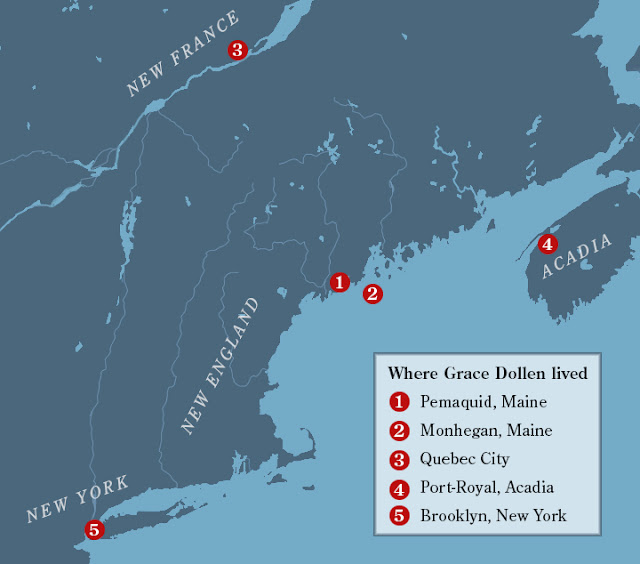
Grace started out life in New England, born in the remote outpost of Pemaquid, Maine in 1659.1 Her father was John Dollen, and it’s believed that her mother was Sarah Gridley. During some of this time, John Dollen lived on an island called Monhegan where he operated a tavern.3 When Grace was growing up, these were dangerous places; the frontier was vulnerable to attacks from Indians, who were often spurred on by the French. During King Philip’s War, Pemaquid was attacked and burned — Grace must have been in the middle of all this as a teenager.

In about 1680, Grace married a Dutchman from New York, Denys Hegeman,1 who was in Pemaquid as a soldier. Between 1681 and 1688, they had four children. But the challenges of where they lived finally had a direct affect on Grace. On August 2, 1689, the Indians attacked Pemaquid and took around 50 settlers captive. Grace and her young daughter Jane were two of them; it’s likely that Jane was killed.4

The places where Grace lived during her life.

After Grace was returned from captivity many years later, she gave testimony describing her ordeal. This was sometimes done by authorities in New England to extract information about the behavior of those who threatened their colony:

“The day when Pemaquid was assaulted and taken by ye Indians, I was there taken prisoner and carried away by them; one Eken, a Canada Indian pretending to have a right in me, and to be my master. I apprehend that there were between two and three hundred Indians at that assault (and no French) who continued there for two days, and then carried myself and other captives (about fifty in number) unto the Fort at Penobscot.

Held as a captive. (AI-generated image)

“I continued there about three years, removing from place to place as the Indians occasionally went, and was very hardly treated by them both in respects of provisions and clothing, having nothing but a torn blanket to cover me during the winter seasons, and oftentimes cruelly beaten. After I had been with the Indians three years, they carried me to Quebec, and sold me for forty crowns unto the French there, who treated me well, gave me my liberty and I had the King’s allowance of provisions, as also a room provided for me, and liberty to work for myself.

“I continued there two years and a half, during which time of my abode there, several of the Eastern Indians came, viz., Bomaseen, Moxis his son, and Madockawondo’s son and diverse others, and brought English prisoners and scalps, and received as the French told me for each scalp (being paid by the intendent) twenty French crowns, according to a declaration which the governor there had emitted for their encouragement, and the captives they sold for as much as they could agree with the purchasers.

“The Indians also had a reward allowed them for bringing intelligence from time to time. Soon after the submission made by the Indians at Pemaquid in 1693, Bomaseen came to Quebec and brought a paper containing the substance of the articles of submission which he showed unto me, and told me that the governor of Canada said to him, that he should not have made peace with the English and he seemed to be much displeased for their having so done, however said they might carry it friendly to the English, till they should meet with a convenient opportunity to do mischief.”4

Grace’s husband Denys made an effort to get her released in 1691 and in the process, was captured himself. In this way, they were reunited for a time in Quebec, and on March 4, 1693, Grace gave birth to a son they named Joseph.5 Denys was given his freedom before Grace; she left Quebec on September 4, 1694, spent the winter in Port Royal, Acadia, then made her way to Boston, arriving in May of 1695.6 She then was reunited with her husband and children at his home in Flatbush, New York.

Baptism of Joseph Hegeman in the New France Catholic parish registers.

Remarkably, for someone who had gone through so much, Grace was able to return to a normal life. She and Denys had another child in 1699,2 but it appears that Denys died in 1702 before their last child was born.6 Now a widow, on April 13, 1703, Grace filed a petition asking for money as a reward for the years of service of her late husband, and she was awarded £50.5 By this time she had become a part of the Dutch community and took on the name “Lucretia.”

Grace probably never went back to her place of birth. She died January 19, 1734 in Flatbush at the age of 75.2 Her lines of descent lived in New York, New Jersey, and later spread across the country — the legacy of a woman who had lived in so many places.

Children:
1. Dollens Hegeman — B. about 1681, Pemaquid, Maine;7 D. before 20 May 1760, (probably) Middlesex, New Jersey;8 M. Geertruy ______, 1703, Middlesex County, New Jersey7

2. Adrian Hegeman — B. about 1683, Pemaquid, Maine;7 D. Aug 1762, Somerset County, New Jersey;7 M. (1) Elizabeth Van Wyck, 15 Dec 1706, Flatbush, New York;7 (2) Sarah ______, before 17199

3. Catharina Hegeman — B. about 1688, Pemequid, Maine;7 M. (1) Hendrick Vonck (1681-?), 12 May 1706, Flatbush, New York;7 M. (2) Anke Lefferts Haughwot, 30 July 17357

4. Jane Hegeman — B. about 1687, Pemaquid, Maine;4 D. about 1689, (probably) Maine4

5. Joseph Hegeman — B. 4 Mar 1693, Quebec City, New France;9 D. 31 Mar 1748, Flatbush, New York;10 M. Alida Andriesz (1699-?), 4 Jun 1714, Flatbush, New York11

6. James Hegeman — B. 18 Jan 1699, Jamaica, New York;2 D. 25 Sep 1736, Hillsborough, New Jersey;2 M. Jannetje Van Vechten (1701-1778), 31 May 17212

7. Denys Hegeman — B. before 29 Jun 1703, (probably) Jamaica, New York;11 D. after 176212

Sources:
1    WikiTree listing of Grace Lucretia (Dollen) Hageman  
2    Transcript of the bible of James and Jannetje Hegeman  
3    Genealogy Dictionary of Maine and New Hampshire, Vol. 2, Charles Thornton Libby, 1929
4    Ten years at Pemaquid: sketches of its history and its ruins, John Henry Cartland, 1899, pp. 141-150
5    Baptismal record of Joseph Hegeman, Quebec Catholic Parish Registers, 1621-1979, FamilySearch.org
6    Henry Cobb Stryker and Amanda Rosetta Walker Their Ancestors and Descendants, Daisy Belle Wikberg, 1971, p. 93
7    “The Tribulations of Denys Hegeman,” Richard W. Cook, Genealogies of New Jersey Families: A-Z, pre-American notes on New Netherland families, 1996
8    Probate record of Dolleus Hegeman, Archives of the State of New Jersey, First Series, Vol. 23, Vol. III of Calendar of Wills
9    Probate record of Adrian Hegeman, Collections of the NY Historical Society, Vol. 30, 1897, p. 171
10  Find-a-Grave listing of Joseph Hegeman
11  The Hegeman Family of New Netherland, John Blythe Dodson  
12  Register of the Early Settlers of Kings County, Long Island, N.Y., Teunis G. Bergen, p. 136

Wheel Maker in Early Massachusetts — Richard Kimball

B. 1595 in Rattlesden, England1
M. (1) before 1615 in England1
Wife: Ursula Scott
M. (2) 23 Oct 1661, (probably) Essex County, Massachusetts1
Wife: Margaret Cole
D. 22 Jun 1675 in Ipswich, Massachusetts1


When Richard Kimball arrived in the Massachusetts colony, he brought a large family and a valuable skill: the ability to construct wooden wheels for carts. This would be needed by many of his fellow settlers as they built communities out of raw wilderness.

Richard was born in Rattlesden, England in 1595.1 It’s likely that his parents were Richard and Elizabeth Kimball, but there is also speculation that they were Henry Kimball and Joann Eisely. Whoever his parents were, many in the Kimball Family around Rattlesden were craftsmen such as wheelwrights, and this is the trade that Richard chose to follow.1

Richard married Ursula Scott before 1615, probably in Rattlesden.1 Between 1615 and 1639, they had at least eleven children; there may have been additional children who died young. All but the youngest three children were born in England.

Rattlesden was located in Suffolk, England. This was a region known as East Anglia, which supplied many Puritans to Massachusetts. In April 1634, Richard and his family joined the migration by boarding the ship Elizabeth, which arrived in Boston a couple of months later.1 Also aboard the ship were his brother Henry Kimball, his brother-in-law, Thomas Scott and his mother-in-law, Martha Scott.2

Richard and his family settled in Watertown, Massachusetts.1 His reputation as someone who knew how to make wheels must have spread to other towns, because a couple of years later, the leaders of Ipswich asked him to settle there. They needed a wheelwright, and they offered him a town lot with a house, plus 40 acres of land for a farm,2 so Richard moved his family to Ipswich and set up his shop. In order to have the materials to work with, the town gave him permission to cut down 20 white oak trees for that purpose.2 One of Richard’s sons, John, also became a wheelwright.2

How wooden wheels for carts were made.

Richard’s name appeared in many town records in Ipswich, some involving disputes with his neighbors. It was also noted that in 1647, he was paid £2 for killing some foxes;2 New England towns often rewarded men for shooting animals who were predators on the community.

Wife Ursula died, and on October 23, 1661, Richard took a second wife, Margaret Cole, who was the widow of a man named Henry Dow.1 Richard passed away on June 22, 1675 in Ipswich.1 He left a detailed will mentioning his living children, some of his grandchildren, and his second wife’s three living children.2 Margaret died on March 11th of the following year.1

As a 17th century immigrant to America, Richard had many noteworthy descendants, including women’s right advocate Lucretia Mott, first lady Edith RooseveltRowland H. Macy (founder of Macy’s), John Sargent Pillsbury (founder of Pillsbury Company), William Robbins Barnes (co-founder of Barnes & Noble), James Taylor, O. Henry, and actors William H. Macy, Mickey Rourke, Kristen Wiig, Ann B. DavisJohn Lithgow, Elisabeth Shue, Dan Aykroyd, and Amy Poehler.3

Children (all by Ursula Scott):
1. Henry Kimball — B. before 12 Aug 1615, Rattlesden, England;4 D. before 17 May 1676, Wenham, Massachusetts;5 M. (1) Mary Riddlesdale (1622-1672), 1640, Wenham, Massachusetts;1 (2) Elizabeth Black1

2. Abigail Kimball — B. before 5 Nov 1617, Rattlesden, England;6 D. 17 Jun 1658, Salisbury, Massachusetts;7 M. John Severance (1615-1682), about 1637, New England8

3. Elizabeth Kimball — B. about 1619, Rattlesden, England;1 D. after 5 Mar 16751

4. Richard Kimball — B. about 1623, Rattlesden, England;1 D. 26 May 1676, Wenham, England;9 M. (1) Mary _____ (?-1672);1 (2) Mary Morris, after 2 Sep 16721

5. Mary Kimball — B. about 1625, Rattlesden, England;1 D. 12 Jul 1686, Ipswich, Massachusetts;10 M. Robert Dutch1

6. Martha Kimball — B. about 1629, Rattlesden, England;1 M. Joseph Fowler (1622-1676)1

7. John Kimball — B. about 1631, Rattlesden, England;1 D. 6 May 1698, Ipswich, Massachusetts;1 M. Mary Bradstreet (1633-1690)1

8. Thomas Kimball — B. about 1633, Rattlesden, England;1 D. 2 May 1676, Bradford, Massachusetts;1 M. Mary Smith (~1635-1688)1

9. Caleb Kimball — B. about 1635, Massachusetts;1 D. before 23 Sep 1682, (probably) Ipswich, Massachusetts;11 M. Anna Hazeltine (1640-1688), 7 Nov 1660, Ipswich, Massachusetts1
10. Benjamin Kimball — B. about 1637, Massachusetts;1 D. 16 Jun 1696, Bradford, Massachusetts;12 M. Mercy Hazeltine (?-1707), 16 Apr 1661, Salisbury, Massachusetts1

11. Sarah Kimball — B. about 1639, Watertown, Massachusetts;1 D. 12 Jun 1690, Suffield, Connecticut;2 M. Edward Allen, 24 Nov 1658, Ipswich, Massachusetts2

Sources:
1    The Great Migration: Immigrants to New England, 1634-1635, Robert Charles Anderson, 1999
2    History of the Kimball Family in America From 1634 to 1897, Leonard Allison Morrison and Stephen Paschall Sharples, 1897
3    FamousKin.com listing of Richard Kimball
4    Baptismal record of Henry Kemball, Notes on the History of the Church and Parish of Rattlesden, 1900
5    Probate inventory of Henry Kimball, Massachusetts, U.S., Wills and Probate Records, 1635-1991, Ancestry.com
6    WikiTree listing of Abigail (Kimball) Severans
7    Death record of Abigail Severans, Massachusetts Deaths and Burials, 1795-1910, FamilySearch.org
8    Marriage record of John Severance and Abigail Kimball, U.S., New England Marriages Prior to 1700, Ancestry.com
9    Death record of Richard Kimball, Massachusetts, Town Clerk, Vital and Town Records, 1626-2001, FamilySearch.org
10  Death record of Mary Dutch, Vital Records of Ipswich, Massachusetts, to the end of the year 1849, Vol. 2, 1910
11  Probate record of Caleb Kimball, Essex County, Massachusetts Probate File Papers, 1638-1674, AmericanAncestors.org
12  Find-a-Grave listing of Benjamin Kimball